Ethernet controllers that move stepper axes and switch inputs and outputs — run by scripts a technician can read and change. Every line is checked before the machine moves.
ENABLE,ALL,ONHOME,ALL,SEQSET,R1,0LABEL,CYCLEWAITIN,1,ONMOVE,X,150WAITMOVEOUTPUT,1,ONDWELLMS,500OUTPUT,1,OFFMOVE,X,0ADD,R1,1LOG,Part {R1} doneSPEAKLINE,Part completeIF,R1,<,100,GOTO,CYCLEEND
A complete machine-control system: the controllers do the time-critical work — step pulses, ramps, limits, homing and E-Stop — while the AMT Script Engine runs the machine from scripts written in plain English.
Ethernet motion and I/O controller: 3 stepper axes (STEP, DIR, ENABLE to external drivers), limit and home inputs, 4 digital inputs, 4 digital outputs, 2 analog inputs, E-Stop.
The same controller for I/O only: 13 digital outputs, 10 digital inputs, 2 analog inputs and 3 fast pulse channels.
Loads, checks and runs scripts, with machine status, jog and home, diagnostics, configuration and spoken operator prompts. Runs one controller or a machine of up to six.
Write and check scripts away from the machine, with a command list and line-by-line checking.
Stands in for the controllers on the PC and shows the machine moving — including an isometric 3D view — so scripts can be tried before any hardware is wired.
Automatic qualification of the software, with a Word report that reads QUALIFIED when every item passes.
SyncSys Ax and SyncSys IO share the same 8.0 × 5.2 in board. Opto-isolated digital I/O, 15–30 Vdc supply, Ethernet with firmware update over the network.
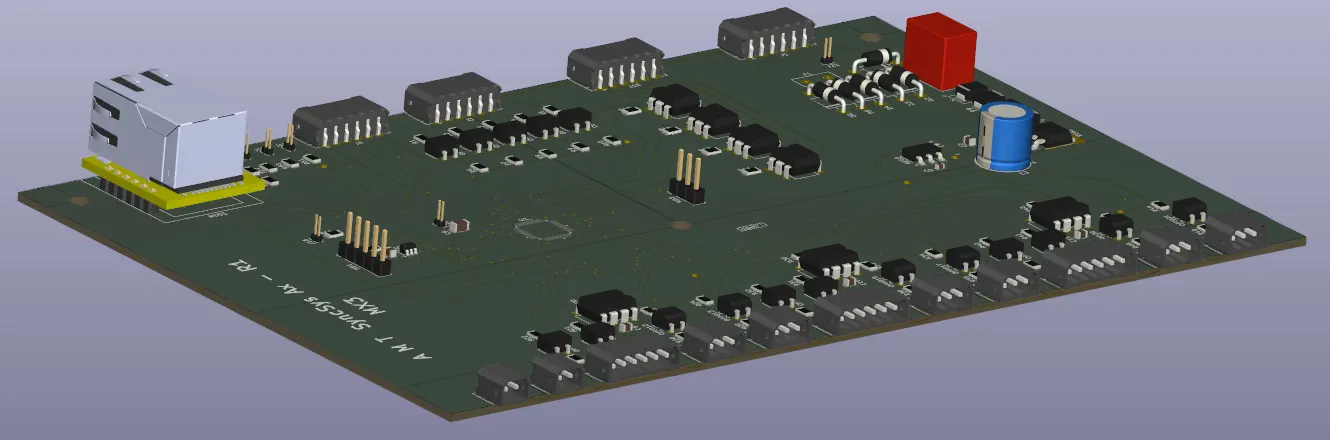
AMT SyncSys controller board — 3D model
| Typically | With AMT SyncSys |
|---|---|
| Ladder logic, structured text or G-code, and a programming package to learn | Plain-English scripts a technician can read and change: HOME,X MOVE,X,150 WAITIN,1,ON |
| Mistakes found when the machine runs | Every line is checked before the script runs; a wrong command, axis, input, output or speed is listed with its line number and reason |
| A lamp or a message on a screen | Spoken operator prompts (SPEAKLINE), on-screen messages and a dated log of every part (LOG) |
| Hardware needed to try a program | AMT Visualizer draws the machine moving on the PC, in an isometric 3D view, before any hardware is wired |
| Validation written up by hand | AMT Test Runner qualifies the software automatically and writes a Word report |
| One fixed axis behavior, or a separate controller for each job | Three modes on every axis: Positioning, Feeder-Index and Spindle |
| Outputs switched by the program scan | Position-synchronized outputs that switch at a set position in the move, in hardware |
| Limit and E-Stop wiring left to the installer | Normally-closed limit inputs (a broken wire reads as tripped) and an E-Stop that gates every step output in hardware |
| A closed protocol and a vendor tool | Open plain ASCII over Ethernet — the controller also works with a PLC or any PC program |
| An industrial panel PC | Runs on a Raspberry Pi 4 with a 10-inch touch display, or a Windows or Linux PC |
Point-to-point motion with I/O — not contour cutting.
Machine-mounted operator panel; the Small layout fits a 1024 × 600 touch screen.
Office or machine PC — script writing, Visualizer and operation.
Machine or office PC. Each platform has its own installer with desktop and menu icons.
Describe the sequence, the axes and the I/O. We'll confirm the configuration and provide a quotation.
Request a Quote →